What Is Edge AI and Why It Matters?
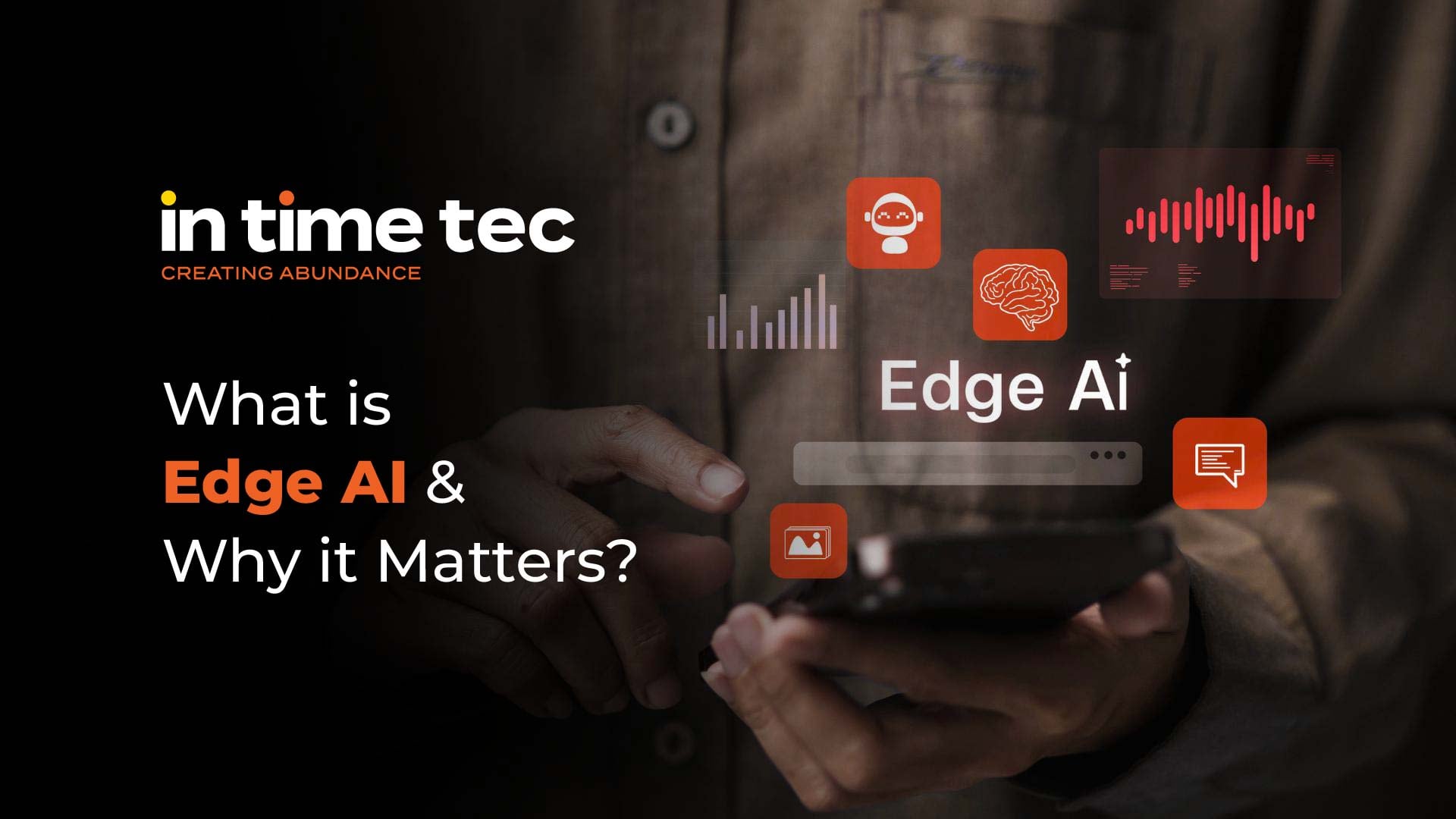

Quick Summary: Edge AI enables artificial intelligence models to process data directly on devices closer to where it is generated. This approach reduces latency, improves real-time decision-making, enhances data privacy, and supports intelligent applications across various industries.
Artificial intelligence is moving closer to where data is created. Instead of sending information to cloud servers for processing, businesses are increasingly running AI models directly on devices such as cameras, sensors, machines, and smartphones.
This shift enables faster decisions, lower operational costs, and stronger data privacy.
According to Fortune Business Insights, the global Edge AI market is projected to grow from USD 46.96 billion in 2026 to USD 445.75 billion by 2034. This growth reflects the rapid adoption of intelligent edge computing across industries.
As organizations continue to generate more real-time data, understanding what is Edge AI is essential for making informed technology investments.
What Is Edge AI?
Edge AI is the practice of running artificial intelligence models directly on devices or edge infrastructure instead of relying entirely on cloud computing.
Traditional AI systems send data to centralized servers for processing before returning a response. Edge AI processes information where it is generated, reducing delays and improving responsiveness.
This approach is especially useful when applications require immediate decisions. Smart cameras, industrial machines, autonomous vehicles, and medical devices all benefit from local intelligence because they cannot afford network latency or unreliable internet connections.
How Does Edge AI Work?
Edge AI combines artificial intelligence with edge computing to process data closer to where it is generated. Instead of sending all information to the cloud for analysis, AI models run directly on edge devices, enabling faster and more efficient decision-making.
Here's how the process works:
1. Data Collection: Sensors, cameras, IoT devices, and connected equipment continuously collect real-time data.
2. Local AI Processing: The data is processed locally using AI models running on specialized hardware such as AI accelerators, neural processing units (NPUs), or edge servers.
3. Real-Time Decision Making: The device analyzes the data and generates immediate insights, predictions, or actions without waiting for cloud-based processing.
4. Cloud Synchronization: Only relevant insights, alerts, or summarized data are sent to the cloud for storage, reporting, advanced analytics, or model training.
5. Continuous Improvement: AI models can be updated and optimized through the cloud, ensuring devices continue to deliver accurate and reliable results over time.
This architecture reduces latency and bandwidth usage while maintaining the benefits of centralized cloud management. As a result, many organizations adopt a hybrid approach that combines local edge intelligence with cloud-based analytics and model training.
Why Edge AI Matters for Modern Businesses
Organizations generate enormous volumes of operational data every day. Cloud-based processing can introduce delays, increase infrastructure costs, and raise data privacy concerns. Edge AI addresses these challenges by bringing intelligence closer to the source of data.
Businesses can respond to events almost instantly, improve customer experiences, reduce network traffic, and maintain operations even when internet connectivity is limited. Faster decision-making has become a competitive advantage in industries where every second matters.
Benefits of Edge AI
The growing adoption of Edge AI is driven by several business advantages.
Some of the key benefits include:
- Faster AI inference with minimal latency
- Lower cloud computing and bandwidth costs
- Improved data privacy and regulatory compliance
- Reliable performance during network outages
- Better scalability for IoT deployments
- Enhanced customer experiences through real-time responses
These advantages explain why organizations are investing heavily in edge computing technologies.
Edge AI for Real-Time Analytics: Use Cases and Examples
One of the biggest advantages of Edge AI is its ability to process and analyze data in real time. Instead of sending information to cloud servers for analysis, edge devices perform AI inference locally, enabling faster decisions and reducing latency.
This capability is particularly valuable for applications that require immediate responses, such as predictive maintenance, fraud detection, video surveillance, and industrial automation. Edge AI enables faster issue detection, improved operational efficiency, and reduced dependence on cloud connectivity.
Common Edge AI Use Cases
Organizations across industries are using Edge AI to improve productivity, safety, and customer experiences:
- Manufacturing: Detect equipment failures before they cause production downtime through predictive maintenance.
- Retail: Analyze customer movement patterns using intelligent cameras to optimize store layouts and improve customer experiences.
- Healthcare: Monitor patients with connected medical devices that generate real-time alerts during emergencies.
- Transportation: Improve vehicle safety and operational efficiency through intelligent monitoring systems.
- Agriculture: Use AI-powered sensors to monitor crop health, soil conditions, and irrigation systems.
- Video Surveillance: Detect suspicious activity and trigger instant alerts without relying on cloud-based processing.
- Fraud Detection: Identify unusual transaction patterns and potential threats in real time.
Edge AI Examples in Everyday Applications
Several real-world examples demonstrate how Edge AI has become part of everyday operations:
- Smartphones use on-device AI for facial recognition and voice assistants without sending sensitive data to the cloud.
- Smart security cameras analyze video feeds locally and generate instant alerts when unusual activity is detected.
- Industrial robots adjust production processes using real-time sensor data to improve efficiency and quality.
- Wearable health devices continuously monitor vital signs and notify users when abnormalities are detected.
- Connected vehicles use Edge AI to support driver assistance and safety features with minimal latency.
The combination of real-time analytics and local AI processing helps organizations respond faster, reduce operational risks, and improve business efficiency.
Challenges in Edge AI Implementations
While Edge AI delivers faster insights and real-time decision-making, implementation is not without challenges. Organizations need to balance performance, security, scalability, and manageability to achieve successful outcomes.
Some of the most common challenges include:
- Limited computing resources: Edge devices typically have less processing power, memory, and storage than cloud environments, requiring AI models to be optimized for efficiency.
- Security concerns: Distributed devices create additional attack surfaces that must be protected through strong security controls and continuous monitoring.
- Large-scale device management: Maintaining and updating thousands of connected devices across multiple locations can become operationally complex.
- Model maintenance: AI models require frequent updates and retraining to ensure ongoing accuracy and reliability.
- System integration: Edge AI solutions often need to work alongside existing cloud platforms, enterprise applications, and IoT ecosystems.
Many organizations address these challenges through a hybrid approach that combines centralized cloud management with decentralized edge processing. This model helps maintain security, scalability, and performance while simplifying operations.
Latest Edge AI Trends Shaping the Future
Edge AI continues to evolve as organizations adopt intelligent, real-time decision-making closer to the source of data.
Some key trends shaping its future include:
1. More Powerful AI Hardware
Advanced AI chips enable faster and more efficient processing on edge devices.
2. Expansion of 5G Connectivity
5G networks support low-latency communication between connected devices and systems.
3. Enterprise-Wide Adoption
Organizations are moving from pilot projects to large-scale Edge AI deployments.
4. Growth of Intelligent Automation
Businesses are using Edge AI to automate decisions and streamline operations.
5. Edge AI and Generative AI Convergence
More organizations are exploring generative AI capabilities at the edge.
6. Wider Industry Adoption
Manufacturing, healthcare, retail, transportation, and smart cities continue to expand Edge AI use cases.
As Edge AI technology matures, localized intelligence is expected to play a central role in future digital transformation initiatives.
Edge AI and Edge Computing: What's the Difference?
Edge AI and edge computing are closely related technologies, but they serve different purposes. While edge computing focuses on processing data closer to its source.
Edge AI adds intelligence by enabling devices to analyze data and make decisions locally without depending on cloud servers.
Here is a quick comparison between Edge AI and Edge Computing:
|
Feature |
Edge Computing |
Edge AI |
|
Purpose |
Processes data near the source |
Processes data and performs AI-driven analysis locally |
|
Focus |
Reducing latency and bandwidth usage |
Enabling intelligent decision-making in real time |
|
Data Processing |
Collects, filters, and processes data |
Analyzes data using AI and machine learning models |
|
Intelligence |
Does not necessarily include AI capabilities |
Uses AI algorithms for predictions and automation |
|
Cloud Dependency |
Reduces reliance on the cloud |
Reduces reliance on the cloud for AI inference |
|
Common Use Cases |
IoT devices, content delivery, data processing |
Smart cameras, predictive maintenance, autonomous systems, healthcare monitoring |
|
Business Benefit |
Faster data processing and lower network costs |
Faster insights, automation, and real-time decision-making |
In simple terms, edge computing provides the infrastructure, while Edge AI provides the intelligence.
Organizations often use both technologies together to support applications such as predictive maintenance, smart surveillance, industrial automation, and real-time analytics.
Local data processing and AI-powered decision-making enable businesses to improve responsiveness. It also enhances operational efficiency and delivers better user experiences.
Conclusion
Edge AI is transforming how organizations process data, make decisions, and respond to events in real time. Businesses can reduce latency, improve operational efficiency, strengthen data privacy, and unlock faster insights with Edge AI.
As adoption continues to grow across industries, Edge AI is becoming a key component of digital transformation initiatives. Organizations that successfully implement Edge AI can create smarter, more responsive systems while reducing reliance on centralized cloud processing.
Scalable and reliable Edge AI solutions require expertise across AI, IoT, embedded systems, and cloud integration. In Time Tec helps organizations design and develop Edge AI applications for intelligent devices, industrial automation, predictive analytics, and connected ecosystems.
Ready to explore Edge AI for your business?
Contact In Time Tec to build scalable, future-ready Edge AI solutions that drive innovation and operational efficiency.
Feel like you could use a hand?
See what’s possible and give your teams the ability to create positive change.
Contact NowLike what you see? Share with a friend:


Elevate your tech savvy! Warning: May cause increased knowledge.
Exclusive technology and development insights, tips, and podcasts await.
.jpg?width=352&name=MLaaS%20(Machine%20Learning%20as%20a%20Service).jpg)