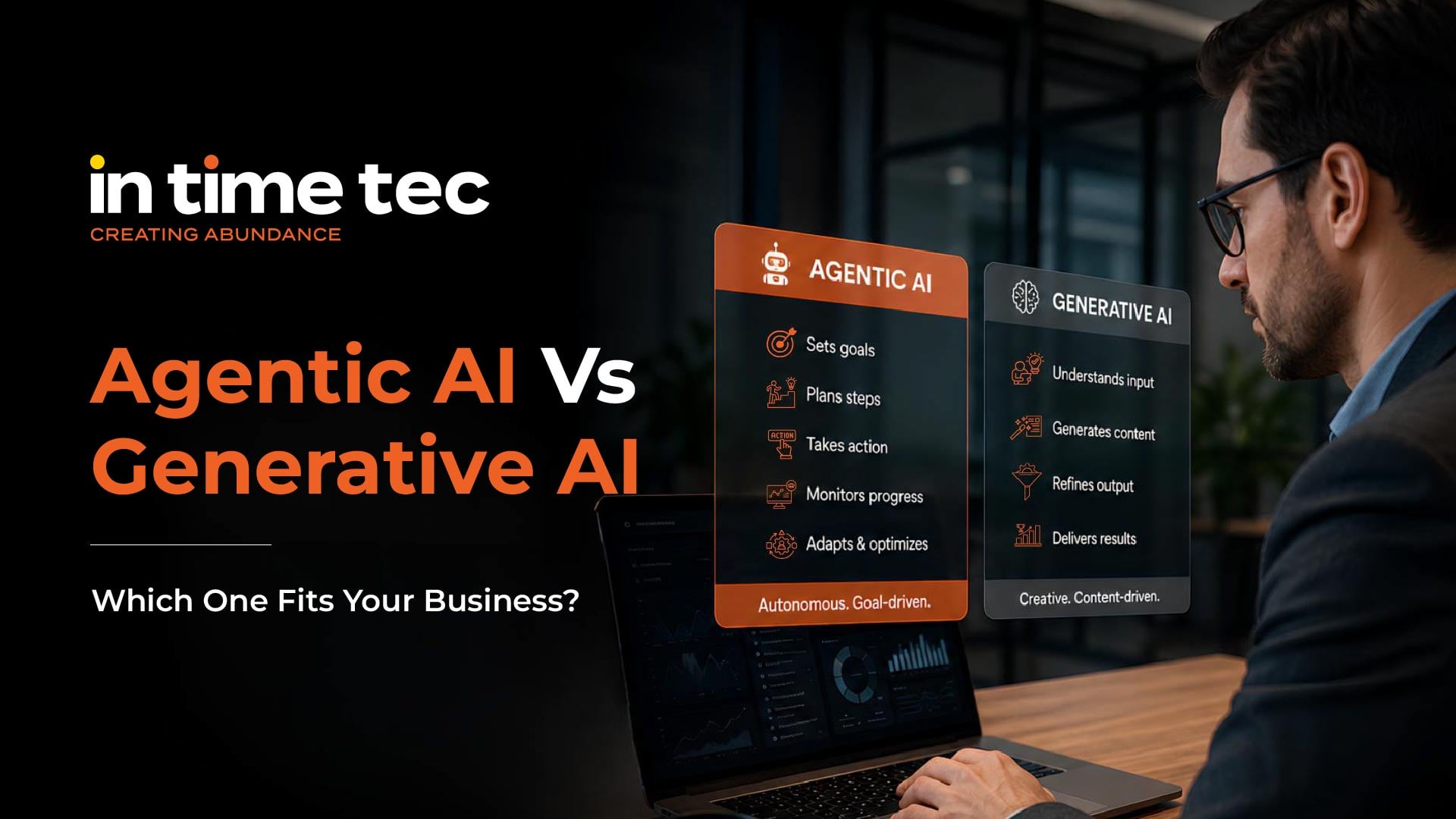
Agentic AI vs Generative AI: Which One Fits Your Business in 2026?

The corporate world has moved beyond the first wave of AI adoption. While businesses initially focused on chatbots and content-generation tools, attention is now shifting toward autonomous systems that can execute tasks and drive outcomes.
The conversation is no longer about whether to adopt AI. Organizations are now evaluating how to transition from assistant-based AI tools to more intelligent, action-oriented frameworks. As a result, the debate around agentic AI vs generative AI has become a key strategic consideration.
This shift is backed by rapid AI adoption trends. Today, over 70% of organizations use generative AI in at least one business function, while overall AI adoption has reached nearly 78–88% globally.
This guide explores the differences between these technologies and helps businesses identify the right approach for their objectives.
What Is Generative AI?
Generative artificial intelligence refers to algorithms that can create new content based on the data they were trained on.
At its core, this technology uses large language models to predict the next most logical word, pixel, or code snippet in a sequence. It acts as an incredibly well-read, highly efficient digital assistant that responds directly to human prompts.
Key Capabilities and Enterprise Use Cases
Generative systems excel at processing vast pools of unstructured data and translating them into clear, actionable outputs. In the enterprise environment, these capabilities typically manifest in a few distinct areas:
- Content Creation and Marketing: Generating localized ad copy, structuring long-form reports, and personalizing email campaigns at scale.
- Software Development: Accelerating engineering cycles by auto-completing code blocks and debugging existing software syntax.
- Knowledge Management: Sifting through internal corporate wikis, compliance documents, and legal contracts to answer complex employee queries instantly.
Benefits and Limitations of Generative AI
Generative AI brings several advantages that make it appealing for modern organizations:
- Delivers immediate value with minimal setup.
- Makes data and information more accessible across teams.
- Helps employees reduce repetitive administrative work.
- Improves productivity through content generation, summarization, and research assistance.
At the same time, there are important considerations to keep in mind when using generative AI:
- Operates reactively and requires human prompts to initiate tasks.
- Cannot independently execute complex workflows across business systems.
- Has limited ability to interact with enterprise software environments without additional integrations.
- Cannot guarantee complete factual accuracy and often requires human review and validation.
- Depends on human oversight for decision-making and execution.
What Is Agentic AI?
Agentic AI represents a paradigm shift from passive text generation to autonomous execution. Instead of waiting for step-by-step instructions, an agentic system is given a high-level objective, a set of permissions, and access to necessary tools.
The system then formulates its own plan, breaks the objective down into sequential tasks, and interacts with external environments to achieve the desired outcome.
This shift is already gaining traction in the enterprise.
Recent studies show that over 60% of organizations are experimenting with AI agents, with nearly one in four actively scaling them in production environments.
This evolution also clarifies the frequent industry confusion regarding AI agents vs agentic AI. While an AI agent is the specific software entity built to perform a task, agentic AI is the broader architectural capability that enables these systems to exhibit reasoning, autonomy, and goal-directed behavior.
Autonomous Decision-Making and Workflow Orchestration
Unlike traditional software that follows rigid, hard-coded rules, agentic systems use multi-step reasoning to navigate unexpected variables. If a database query fails or an external API returns an error, the agent analyzes the failure and attempts an alternative path to complete the goal.
These systems seamlessly connect with enterprise resource planning systems, customer relationship management platforms, cloud databases, and AI data centers to execute workloads at scale while ensuring reliability and safety.
Common Enterprise Applications
Agentic AI is gaining traction across industries because it can manage complex workflows with minimal human oversight. Instead of simply generating outputs, these systems analyze information, make decisions, and take action to achieve predefined business objectives.
- Supply Chain Management: Predicting inventory shortages and automatically placing orders with approved vendors.
- IT Operations Automation: Identifying system issues, diagnosing causes, and deploying fixes with minimal intervention.
- Business Process Automation: Streamlining audits, invoice reconciliation, and compliance monitoring across operations.
Benefits and Limitations of Agentic AI
Agentic AI offers several powerful advantages, especially for organizations looking to automate and scale complex operations:
- Automates complex, multi-step business processes with minimal human intervention.
- Makes decisions and takes actions based on predefined goals and real-time data.
- Improves operational efficiency by reducing manual effort and response times.
- Enable continuous monitoring and optimization of workflows.
- Scales business operations without proportionally increasing workforce requirements.
- Integrates with enterprise systems to execute tasks across multiple applications.
At the same time, adopting agentic AI comes with important considerations:
- Requires significant planning, governance, and system integration.
- Involves higher implementation costs compared to generative AI tools.
- May introduce compliance, security, and accountability challenges if not properly managed.
- Depends heavily on the quality of data, rules, and objectives provided.
- Requires ongoing monitoring to prevent unintended actions or outcomes.
- Is not suitable for every business process, particularly those requiring nuanced human judgment or high-stakes decision-making.
Agentic AI vs Generative AI: Key Differences
While both technologies leverage advanced AI models, their capabilities and business applications differ significantly. Understanding these distinctions is essential for organizations looking to align AI investments with their operational and strategic goals.
|
Feature |
Generative AI (Low Autonomy) |
AI Agents (High Autonomy) |
|
Autonomy |
Entirely dependent on continuous human prompting. |
Operates independently within defined guardrails. |
|
Decision-Making |
Predicts the next logical data point based on training patterns. |
Evaluates choices, weighs risks, and chooses the best path forward. |
|
Output Type |
Text, code, images, audio, or data summaries. |
Completed workflows, system updates, and executed processes. |
|
Human Involvement |
High. Required for prompting, editing, and execution. |
Low. Humans act as supervisors, auditors, and goal-setters. |
|
Workflow Execution |
Cannot interact with external software platforms independently. |
Connect directly to enterprise APIs, databases, and applications. |
|
Adaptability |
Confined the context provided in the immediate prompt. |
Adjusts tactics dynamically if it encounters errors or obstacles. |
|
Scalability |
Scaled by increasing human usage and prompt frequency. |
Scaled by deploying agents across parallel operational pipelines. |
|
Business Impact |
Boosts individual worker speed and creative output. |
Drives systemic operational efficiency and lowers operational overhead. |
You can also check the difference between Generative AI and Predictive AI here.
Where Generative AI Delivers the Most Value
Generative tools remain at the gold standard for projects centered around ideation, summarization, and human-in-the-loop collaboration. If your primary goal is to accelerate the creative or analytical output of your workforce, this is your best starting point.
In customer engagement, these models empower agents by instantly pulling relevant client histories and drafting personalized responses. In knowledge management, they turn complex technical manuals into easily digestible summaries for field technicians.
Technology is ideal for industries like legal services, marketing, and corporate education, where text synthesis and rapid drafting save thousands of manual hours annually.
Where Agentic AI Creates Competitive Advantage
When evaluating gen ai vs agentic ai, the latter emerges as the definitive choice for complex, high-volume operational environments. Agentic systems excel when a business problem requires cross-platform process management and independent decision-making.
From an AI architecture perspective, these systems are designed to integrate multiple models, tools, and data layers into a cohesive, goal-driven framework that enables scalable automation and real-time decision execution.
Consider a modern logistics firm. A generative tool can draft an email apologizing for a delayed shipment. An agentic system, however, will proactively detect the weather delay, calculate alternative shipping routes, check warehouse availability, rebook the cargo, update the client's account profile, and alert the account executive.
This level of comprehensive process of orchestration explains why market leaders view agentic architecture as the true engine of modern corporate scaling.
Can Businesses Use Both Together?
The choice of an AI strategy does not require making an exclusive, either-or decision. In fact, the most sophisticated enterprise architectures built today intentionally blend both technologies into a unified operational ecosystem.
To understand how this works in a practical scenario, look at the contrast between traditional artificial intelligence vs generative artificial intelligence and modern agentic setups. A complete modern marketing pipeline showcases this synergy perfectly:
- The Creative Phase: A generative model creates localized product descriptions and visual assets for a global campaign.
- The Operational Phase: An agentic framework takes those assets, verifies inventory availability in the target region, schedules the ads across media platforms, monitors real-time ad spend efficiency, and reallocates the budget dynamically based on performance metrics.
Enterprises marry creative capabilities with autonomous execution to build highly scalable, self-optimizing business units.
How to Choose the Right AI Strategy in 2026
Your capital allocation should depend entirely on your current operational bottlenecks and your long-term business objectives.
1. Choose Generative AI If:
Your main goal is to accelerate employee productivity and eliminate administrative drafting work.
Your workflows require a human to review, edit, and approve every single piece of output before it goes live.
You need to build intuitive semantic search tools over vast internal corporate knowledge bases.
2. Choose Agentic AI If:
You need to automate complex corporate workflows that span multiple legacy software platforms and databases.
You want to reduce human operational bottlenecks in high-volume areas like supply chains, IT monitoring, or financial billing.
Your operational goals require systems to run continuously in the background, making real-time decisions within predefined corporate guardrails.
3. Choose Both If:
You are planning a comprehensive, enterprise-wide digital transformation across multiple business units.
You want to build an agile organization where humans focus entirely on strategy, governance, and creative direction, while the underlying software manages execution.
The Future Outlook: The Rise of Autonomous Enterprises
The enterprise technology landscape is rapidly shifting from fragmented digital tools toward integrated software orchestration platforms. Over the next few years, the reliance on isolated software assistants will give way to cohesive networks of interacting agents.
These systems will collaborate with one another, securely passing data and tasks across departments to optimize entire corporate value chains.
This evolution will fundamentally change human-AI collaboration models. The role of the enterprise worker will shift from execution to governance.
Instead of writing code, drafting emails, or manually cross-referencing spreadsheets, professionals will act as strategic managers, defining parameters, auditing agent performance, and ensuring strict adherence to compliance standards.
Conclusion
The choice between generative AI and agentic AI is not about selecting one over the other. It is about identifying the right technology to solve your business challenges and create measurable value.
As organizations move beyond conversational AI toward intelligent automation, a well-defined strategy becomes essential. Success depends on aligning AI investments with operational goals, business processes, and long-term growth objectives.
At In Time Tec, a trusted Generative AI development company, our AI consulting and development experts help businesses design, build, and scale AI solutions that deliver real business outcomes. From generative AI applications to advanced agentic systems, we help organizations transform AI potential into tangible results.
Ready to unlock the next stage of AI-driven growth? Connect with our team to explore the right AI strategy for your business.
Feel like you could use a hand?
See what’s possible and give your teams the ability to create positive change.
Contact NowLike what you see? Share with a friend:


Elevate your tech savvy! Warning: May cause increased knowledge.
Exclusive technology and development insights, tips, and podcasts await.