Top 10 Types of AI Agents You Need to Know in 2026

How are businesses managing rising workloads, growing data, and the constant need for faster results? The answer lies in smarter systems, and AI agents are becoming a key part of that shift.
AI adoption continues to grow across industries. Around 78 percent of companies already use AI in at least one business function, and many are expanding its role across operations. Teams now rely on AI to automate tasks, improve efficiency, and support faster decision-making.
The growing availability of AI as a service (AIaaS) is also making it easier for organizations to access advanced AI capabilities without heavy infrastructure investments.
AI agents are emerging as the next step in this evolution. More than 60 percent of organizations are already experimenting with AI agents, and many see them as a competitive advantage. These systems can understand context, make decisions, and take actions with minimal human input.
However, not all AI agents work the same way. Some follow predefined rules, while others learn, adapt, and collaborate across complex workflows. It is important to understand the different types of AI agents. This helps businesses choose the right solutions and avoid costly mistakes.
In this guide, we cover the most important AI agent types, how they work, and where they deliver real value.
Simple Reflex Agents
Simple reflex agents represent the most basic category among the types of agents in AI. They operate using predefined rules and respond directly to specific inputs without considering past experiences or future outcomes.
These agents follow an "if-then" approach. When a particular condition is met, a corresponding action is triggered immediately.
Because of their simplicity, reflex agents work best in environments where tasks are predictable and require limited decision-making. They are fast, efficient, and easy to implement.
AI Agents Examples:
- Basic customer service chatbots
- Automatic email response systems
- Password reset assistants
- Simple ticket-routing tools
While these agents are effective for routine tasks, they struggle when situations become more complex or require contextual understanding.
Model-Based Reflex Agents
Model-based reflex agents build upon the capabilities of simple reflex agents by maintaining an internal representation of their environment.
Instead of reacting only to current inputs, these agents consider information gathered from previous interactions. This additional context allows them to make more informed decisions.
For example, if a system detects unusual activity across multiple events rather than a single event, it can respond more accurately.
Businesses often use model-based agents in environments where conditions change frequently, and decisions depend on more than one data point.
AI Agents Examples:
- IT infrastructure monitoring systems
- Smart inventory management platforms
- Industrial equipment monitoring solutions
- Security surveillance systems
Their ability to understand context makes them more adaptable than basic rule-based systems.
Goal-Based Agents
Goal-based agents are designed to achieve specific objectives. Rather than simply responding to inputs, they evaluate different actions and select the one most likely to achieve a desired outcome.
These agents assess multiple possibilities before making a decision. This capability makes them particularly useful in situations that require planning and strategic thinking.
For organizations dealing with complex workflows, goal-based agents can significantly improve efficiency and decision quality.
AI Agents Examples:
- Logistics route optimization systems
- Delivery scheduling platforms
- Workforce planning solutions
- Resource allocation tools
Among the different types of agents in AI, goal-based agents are often preferred when businesses need systems that can actively work toward measurable objectives.
Utility-Based Agents
Utility-based agents take decision-making one step further. Instead of simply achieving a goal, they aim to achieve the best possible outcome.
These agents evaluate available options based on predefined utility values such as cost, efficiency, speed, customer satisfaction, or risk.
When multiple solutions can achieve the same goal, utility-based agents determine which option delivers the highest overall value. This optimization is typically enabled by a well-designed AI architecture that supports complex evaluation models.
This makes them highly effective in environments where optimization plays a critical role.
AI Agents Examples:
- Dynamic pricing systems
- Product recommendation engines
- Marketing campaign optimization platforms
- Energy management solutions
Organizations often adopt utility-based agents when they need to balance competing priorities and maximize business outcomes.
Learning Agents
Learning agents continuously improve their performance through experience. Rather than relying solely on predefined rules, they adapt based on feedback, outcomes, and new information.
This adaptability makes them one of the most valuable AI agent types for organizations operating in rapidly changing environments.
As these agents process more data, they become increasingly effective at identifying patterns and improving decisions.
Businesses that prioritize continuous improvement often benefit significantly from learning agents.
AI Agents Examples:
- Fraud detection systems
- Customer behavior analysis platforms
- Predictive maintenance solutions
- Personalized recommendation engines
Their ability to evolve over time allows organizations to respond more effectively to changing market conditions and customer expectations.
Hierarchical Agents
Hierarchical agents organize decision-making into multiple layers. Higher-level agents focus on strategic objectives, while lower-level agents execute specific tasks.
This structured approach helps manage complex operations that involve numerous activities occurring simultaneously.
Each layer handles a specific responsibility, improving coordination, and reducing operational complexity.
Large organizations often use hierarchical architectures to maintain control while ensuring efficient execution.
AI Agents Examples:
- Manufacturing automation systems
- Warehouse management platforms
- Enterprise operations management solutions
- Smart factory environments
Among the types of intelligent agents in AI, hierarchical agents are particularly effective for large-scale business processes that require coordination across multiple functions.
Multi-Agent Systems
Multi-agent systems consist of multiple independent agents working together to achieve shared goals.
Each agent may have a specific responsibility, but they communicate and collaborate to solve larger problems.
This distributed approach improves scalability, flexibility, and resilience. If one agent encounters an issue, others can continue performing their tasks.
Businesses dealing with large operational ecosystems frequently use multi-agent architectures.
AI Agents Examples:
- Supply chain management networks
- Smart transportation systems
- Financial trading environments
- Large-scale logistics operations
As organizations become increasingly interconnected, multi-agent systems continue to gain importance across industries.
Collaborative Agents
Collaborative agents are designed to work alongside humans rather than replace them.
These systems support employees by providing recommendations, insights, and automation while keeping people involved in critical decision-making processes.
Many organizations prefer collaborative agents because they combine technological efficiency with human judgment.
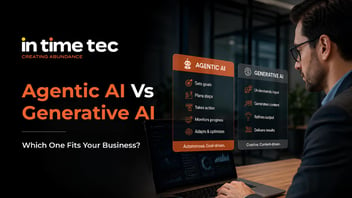
This approach also plays a key role in discussions around agentic AI vs generative AI, where collaborative and decision-making capabilities differentiate agentic systems from content-focused AI models.
It helps businesses increase productivity without sacrificing oversight and accountability.
AI Agents Examples:
- Virtual workplace assistants
- Customer service support tools
- Sales enablement platforms
- Healthcare decision-support systems
Collaborative agents have become particularly valuable for knowledge workers who need quick access to information and actionable recommendations.
Autonomous Agents
Autonomous agents operate independently with minimal human intervention. Once deployed, they can assess situations, make decisions, and execute actions within predefined boundaries.
These agents are ideal for environments that require continuous monitoring and rapid responses.
Because they can function around the clock, autonomous agents often improve operational efficiency and reduce response times.
Businesses seeking greater automation frequently explore autonomous systems as part of their digital transformation strategies.
AI Agents Examples:
- Cybersecurity monitoring platforms
- Automated network management systems
- Smart energy grids
- Autonomous inspection solutions
While autonomy offers significant benefits, organizations must establish appropriate governance and oversight mechanisms to ensure responsible operation.
Hybrid Agents
Hybrid agents combine features from multiple agent categories to address more complex business requirements.
For example, a hybrid agent may incorporate learning capabilities, goal-based planning, and utility-based optimization within a single system.
This flexibility allows businesses to tackle sophisticated challenges without relying on a single decision-making model.
As enterprise requirements become more complex, hybrid architectures are becoming increasingly common.
AI Agents Examples:
- Enterprise automation platforms
- Advanced customer experience solutions
- Intelligent business operations systems
- End-to-end workflow orchestration tools
Many modern business applications use hybrid approaches because they provide the adaptability and intelligence required for real-world environments.
How to Choose the Right Type of AI Agent for Your Business
The right AI agent depends on clear goals and well-defined requirements. Businesses need to understand what they want to achieve and how AI will support their operations.
It’s also important to evaluate solutions offered by leading AI companies, as their expertise, tools, and implementation approaches can significantly impact outcomes.
To make the right decision, focus on these key factors:
- Identify the main business challenge you want to solve
- Match AI agent capabilities with your business goals
- Evaluate workflow complexity and task requirements
- Consider future growth and scalability needs
- Check how well the agent can adapt over time
- Balance automation with the right level of human involvement
Conclusion
A clear understanding of the different types of AI agents helps businesses choose solutions that align with their goals and avoid unnecessary investments.
Each type of AI agent offers unique strengths. The right choice depends on business objectives, system complexity, scalability needs, and the level of automation required.
AI agents now play a key role in digital transformation. They help businesses streamline operations, improve efficiency, and support smarter decision-making across functions. The right AI agent strategy can drive measurable results and support long-term growth.
At In Time Tec, we help organizations evaluate, design, and implement artificial intelligence solutions tailored to their needs. Our approach focuses on improving efficiency, enhancing customer experiences, and enabling intelligent automation on a scale.
Feel like you could use a hand?
See what’s possible and give your teams the ability to create positive change.
Contact NowLike what you see? Share with a friend:


Elevate your tech savvy! Warning: May cause increased knowledge.
Exclusive technology and development insights, tips, and podcasts await.