How AI and Machine Learning Are Transforming High-Tech Industries?
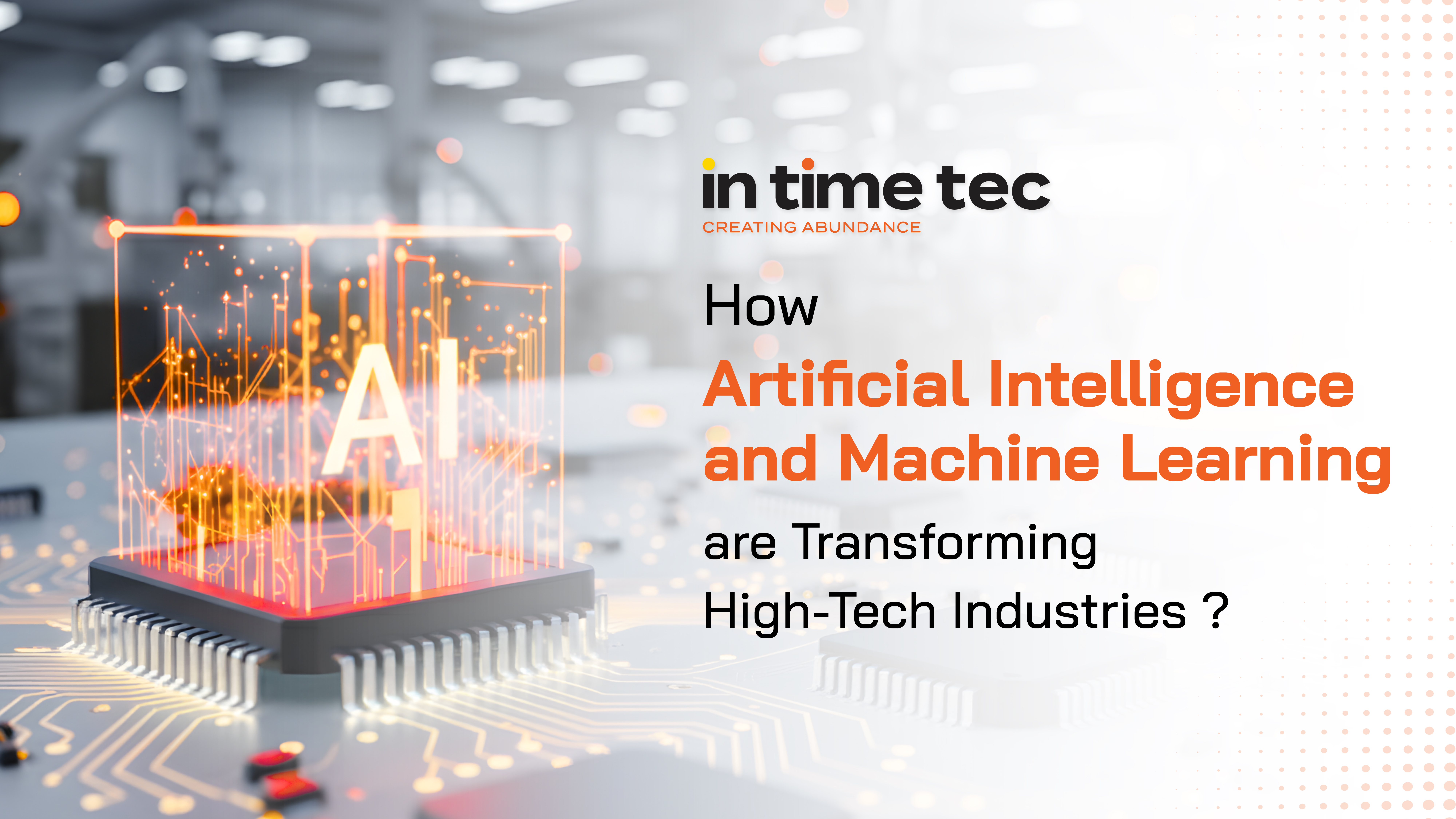

Artificial intelligence and machine learning have become essential technologies for modern businesses. Organizations use AI to automate workflows, improve decision making, strengthen cybersecurity, and deliver better customer experiences. Machine learning adds another layer of intelligence by learning from data and improving predictions over time.
This blog explains how AI is transforming the high-tech industry, how machine learning works, key business applications, and what technology leaders should consider when building an AI strategy in 2026.
Artificial Intelligence Is Driving the Next Wave of Innovation
Artificial intelligence has moved far beyond experimentation. Companies now rely on AI to improve operations, accelerate software development, and make informed business decisions. Stronger computing power, cloud platforms, and access to enterprise data have made AI more practical for organizations of every size.
According to McKinsey's The State of AI 2025 survey, 88% of organizations now use AI in at least one business function, up from 78% a year earlier.
Technology leaders also recognize that AI is no longer a competitive advantage reserved for a few innovators. Every organization must evaluate how intelligent systems can improve productivity, reduce costs, and create better experiences for customers and employees.
Government initiatives and responsible AI & ML frameworks continue to support enterprise adoption across many regions, including Australia. Greater attention to governance, privacy, and cybersecurity helps organizations adopt AI with confidence while meeting regulatory expectations.
Modern enterprises no longer ask whether AI should become part of their business strategy. Leadership teams now focus on identifying the right use cases, selecting reliable technology partners, and creating a roadmap that delivers measurable business outcomes.
What Is AI in Tech?
Artificial intelligence in technology refers to computer systems that perform tasks requiring human intelligence. These tasks include learning from data, recognizing patterns, understanding language, solving problems, and making recommendations.
Traditional software follows predefined instructions. AI systems improve as they process new information, making them more effective over time. This ability allows businesses to respond faster to changing market conditions and customer expectations.
Today, AI supports many business functions, including:
- Software development
- Cybersecurity
- Cloud infrastructure management
- Customer service
- Data analytics
- Predictive maintenance
- Intelligent document processing
- Business process automation
Organizations that successfully integrate AI into daily operations often improve efficiency while creating new opportunities for innovation.
How Does Machine Learning Work?
Machine learning is a branch of artificial intelligence that enables computers to learn from historical data instead of relying only on predefined rules.
A machine learning model follows a structured process.\
- Collect relevant business data.
- Clean and prepare the data for analysis.
- Train the algorithm using historical information.
- Test the model to measure accuracy.
- Deploy the model into business applications.
- Continue learning as new data becomes available.
This process allows machine learning systems to improve predictions without constant manual programming.
Consider a manufacturing company that wants to reduce equipment failures. Machine learning analyzes sensor data collected from machines, identifies patterns linked to previous breakdowns, and predicts when maintenance is required.
Early maintenance reduces downtime, lowers repair costs, and improves operational efficiency. Similar approaches support fraud detection, demand forecasting, recommendation engines, and predictive analytics across many industries.
Why Is AI in the IT Industry Growing Rapidly?
The rapid growth of enterprise applications, cloud computing, and digital services has increased the complexity of IT operations. Manual processes alone cannot keep pace with this scale.
AI helps IT teams monitor infrastructure, identify performance issues, automate software testing, improve cybersecurity, and optimize cloud resources. Development teams also use AI-powered coding assistants to accelerate software delivery while maintaining quality.
Organizations that adopt AI across the software development lifecycle often deliver products faster and respond more effectively to changing business needs.
As AI capabilities continue to mature, technology leaders increasingly view AI as a strategic investment rather than another software tool.
AI Automation for Business Is Redefining Enterprise Operations
AI automation for business combines artificial intelligence with workflow automation to handle repetitive tasks, analyze large volumes of data, and support faster decision making. Traditional automation follows fixed rules. AI powered automation learns from historical data and adapts as business conditions change.
Technology leaders are adopting AI automation because it improves productivity while allowing employees to focus on strategic work. Faster execution, better accuracy, and real time insights help organizations remain competitive in rapidly changing markets.
Several business functions already benefit from AI automation:
- Customer support
- Software development
- Finance
- Human resources
- Sales and marketing
- Supply chain management
- Manufacturing
- Cybersecurity
Every successful implementation begins with a clear business objective rather than technology alone.
Traditional Automation Versus AI Automation
The below comparison shows why many organizations now invest in intelligent automation instead of relying only on traditional workflow automation.
|
Traditional Automation |
AI Automation |
|
Follows predefined rules |
Learns from historical data |
|
Handles repetitive tasks |
Supports intelligent decision making |
|
Requires manual updates |
Improves with new data |
|
Limited flexibility |
Adapts to changing conditions |
|
Best for structured processes |
Handles structured and unstructured data |
Real World Applications Across High Tech Industries
AI continues to create value across almost every business function. Each implementation solves a different challenge while improving efficiency and business performance.
1. Software Development
Development teams use AI to improve speed and code quality throughout the software development lifecycle.
Common applications include:
- Code generation
- Automated testing
- Bug detection
- Code review
- Documentation support
- Release planning
Development teams spend less time on repetitive work and more time building innovative products.
2. Cybersecurity
Cybersecurity teams process thousands of alerts every day. AI helps security professionals identify high-priority threats much faster.
AI supports cybersecurity through:
- Threat detection
- Malware analysis
- Network monitoring
- User behavior analysis
- Fraud detection
- Incident response
Early detection helps reduce business risks while improving overall security posture.
3. Cloud Operations
Cloud environments continue to grow in size and complexity. AI helps IT teams maintain performance without increasing operational workloads.
Organizations use AI to:
- Monitor infrastructure
- Predict system failures
- Optimize cloud resources
- Reduce downtime
- Improve application performance
Reliable cloud operations improve customer experiences while lowering infrastructure costs.
4. Customer Experience
Customer expectations continue to increase across every industry. AI helps organizations deliver faster and more personalized support.
Popular AI applications include:
- Intelligent chatbots
- Virtual assistants
- Personalized recommendations
- Customer sentiment analysis
- Automated ticket routing
Better customer experiences often lead to stronger loyalty and higher customer satisfaction.
5. Manufacturing
Manufacturers generate large amounts of operational data every day. AI converts this information into practical business insights.
Common use cases include:
- Predictive maintenance
- Quality inspection
- Production planning
- Inventory optimization
- Energy management
Predictive maintenance remains one of the most valuable AI applications because it reduces equipment failures before they occur.
Benefits of AI and Machine Learning
Organizations investing in AI often achieve measurable improvements across several business areas.
|
Business Benefit |
Impact |
|
Faster decision making |
Improves business agility |
|
Workflow automation |
Reduces manual effort |
|
Predictive analytics |
Improves planning accuracy |
|
Better customer experiences |
Increases customer satisfaction |
|
Stronger cybersecurity |
Detects threats earlier |
|
Higher productivity |
Allows teams to focus on innovation |
|
Cost optimization |
Reduces operational expenses |
|
Continuous learning |
Improves business performance over time |
Success depends on selecting the right business problems and measuring results throughout implementation.
Best Practices for Enterprise AI Adoption
Technology leaders should approach AI as a long-term business initiative rather than a standalone project.
Several best practices help organizations maximize return on investment.
- Define clear business objectives.
- Build a strong data foundation.
- Select high value use cases.
- Establish responsible AI governance.
- Train employees alongside technology implementation.
- Measure business outcomes regularly.
- Scale successful projects across the organization.
Organizations following these practices often achieve faster adoption while reducing implementation risks.
How In Time Tec Helps Organizations Accelerate AI Adoption
Artificial intelligence initiatives require more than advanced technology. Successful implementation depends on strong engineering expertise, scalable architecture, and a clear understanding of business objectives.
In Time Tec helps organizations design, develop, and implement AI driven solutions that improve operational efficiency and support long term business growth. Our engineering teams combine expertise in software development, cloud technologies, data engineering, and intelligent automation to build solutions tailored to enterprise needs.
Every engagement focuses on solving practical business challenges through secure, scalable, and future-ready technology solutions. This approach helps organizations accelerate digital transformation while creating measurable business value.
AI Challenges Businesses Should Prepare For
AI offers significant opportunities, but successful adoption requires careful planning. Organizations that address common challenges early are more likely to achieve long term success.
Technology leaders should pay close attention to the following areas:
- Data Quality: AI models depend on accurate and complete data. Poor quality data often leads to unreliable predictions and weaker business outcomes.
- Security and Privacy: Enterprise AI systems process large volumes of business and customer information. Strong security measures and privacy policies help protect sensitive data while maintaining customer trust.
- Skills and Change Management: Employees need the right training to work effectively with AI-powered tools. Clear communication and continuous learning also encourage greater adoption across teams.
- Responsible AI: Transparency, fairness, and accountability remain essential for every AI initiative. Organizations should establish governance policies that reduce bias and support ethical decision making.
A balanced approach helps businesses build AI solutions that are secure, reliable, and aligned with business goals.
Future Trends Shaping High Tech Industries
Artificial intelligence continues to evolve at a rapid pace. Several emerging trends are expected to influence enterprise technology strategies throughout 2026 and beyond.
1. AI Agents
AI agents can complete complex tasks with minimal human intervention. These systems analyze information, make decisions, and perform actions across multiple business applications.
Organizations are beginning to use AI agents for customer support, software development, workflow automation, and business operations.
2. Generative AI
Generative AI continues to expand beyond content creation. Businesses now use these models for software development, product design, knowledge management, and business research.
Technology leaders increasingly view Generative AI as a productivity tool that supports innovation across departments.
3. Predictive Analytics
Businesses generate more operational data every year. Predictive analytics help organizations identify patterns, forecast future outcomes, and make proactive business decisions.
Applications include demand forecasting, predictive maintenance, fraud detection, and financial planning.
4. Intelligent Automation
Automation continues to become more intelligent as AI capabilities improve. Modern systems learn from historical data and adapt to changing business conditions without requiring constant manual updates.
Organizations that combine automation with AI often achieve greater efficiency and stronger business performance.
Key Takeaways
Artificial intelligence is transforming the high-tech industry through practical business applications rather than experimental projects.
Technology leaders should remember these key points.
- AI improves efficiency across software development, cybersecurity, customer support, and business operations.
- Machine learning helps organizations make faster and more accurate decisions through data analysis.
- AI automation for business supports productivity while reducing repetitive manual work.
- Responsible AI practices build trust and reduce implementation risks.
- Long term success depends on strong data, skilled teams, and clear business objectives.
Organizations that begin with focused use cases and scale gradually often achieve the best results.
Conclusion
Artificial intelligence and machine learning are transforming the high-tech industry by helping organizations improve efficiency, strengthen cybersecurity, accelerate software development, and make smarter business decisions.
AI in the IT industry has evolved from an emerging technology into a strategic business capability that drives innovation and long-term growth.
Successful AI adoption depends on strong data, responsible governance, skilled teams, and clearly defined business goals. Organizations that combine these elements with AI automation for business are better positioned to adapt to changing market demands and unlock greater value from their technology investments.
At In Time Tec, we help enterprises build secure, scalable, and AI powered solutions that solve real business challenges and support long term digital transformation.
Feel like you could use a hand?
See what’s possible and give your teams the ability to create positive change.
Contact NowLike what you see? Share with a friend:


Elevate your tech savvy! Warning: May cause increased knowledge.
Exclusive technology and development insights, tips, and podcasts await.